Design for Manufacturing (DFM): How to Prep Your Prototype for Mass Production
The excitement of holding a finalized, fully functional MVP prototype in your hands is unmatched. Your circuit boards are communicating flawlessly, the internal wiring layout is secured, and the physical aesthetic matches your original vision. However, a common trap for independent inventors is assuming that a successful laboratory prototype is automatically ready for the factory assembly line.
To transition smoothly from a low-volume prototype to high-volume mass production, your project must undergo a rigorous engineering process known as Design for Manufacturing (DFM).
DFM optimizes your product’s digital blueprints and material choices so that factories can manufacture your invention at the lowest possible cost, with the highest possible speed, and minimal defect rates.
1. Wall Thicknesses and Uniform Draft Angles
When fabricating an early-stage prototype, technologies like rapid 3D printing allow for complex, solid geometric structures. However, mass production lines rely heavily on high-speed injection molding for plastic and composite enclosures.
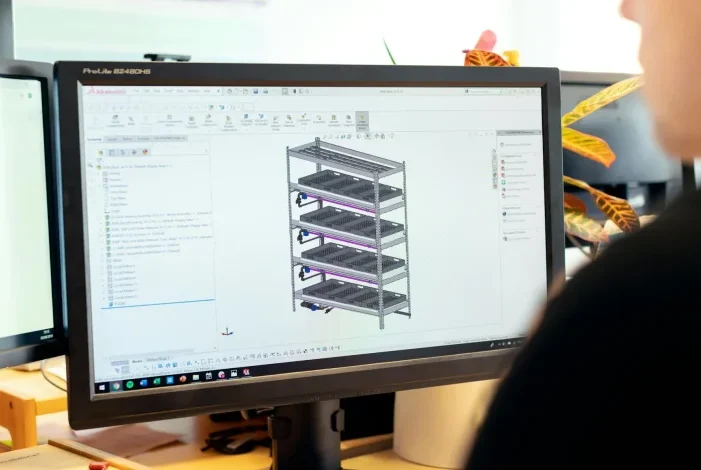
Injection molding requires liquid raw material to flow evenly into a steel mold tool, cool rapidly, and eject cleanly without warping. To achieve this, DFM engineering refines your 3D CAD models to ensure uniform wall thicknesses across the entire casing. Additionally, engineers add subtle slopes called draft angles to every vertical surface. These microscopic slants act as a release mechanism, preventing the factory machinery from scraping or cracking your product as it pops out of the steel tool.


2. Reducing Part Counts and Complex Assemblies
In manufacturing, every additional screw, snap-fit joint, or internal bracket adds cost. More parts mean longer manual assembly lines, a higher chance of worker error, and increased structural failure points.
During a professional DFM review, engineers look for opportunities to merge separate components into unified structures. If a complex three-piece internal frame can be engineered as a single molded snap-lock piece, your production costs drop dramatically. Simplifying your product's internal architecture slashes assembly time and simplifies quality control checks on the factory floor.
3. Optimizing Tooling Lifespans and Material Choices
The most significant upfront expense in launching a physical product is the "tooling cost"—the price of machining the precision steel or aluminum molds used by factory presses. Poorly designed parts cause uneven thermal stress, which destroys these expensive molds prematurely.
DFM software simulates manufacturing conditions to analyze how materials will flow and cool inside the factory tooling. By selecting production-grade materials that match your product's performance needs and modifying high-friction design lines early, you extend the lifespan of your factory molds from 10,000 cycles to over 100,000 cycles. This structural foresight saves tens of thousands of dollars in replacement hardware downstream.
Engineering for Scalability
An elite prototype doesn’t just prove that your idea works; it proves that your idea can be successfully brought to the global market. By integrating Design for Manufacturing principles right into your prototyping sprint, you bridge the gap between abstract design and industrial scaling—ensuring your product arrives on retail shelves exactly as intended.